


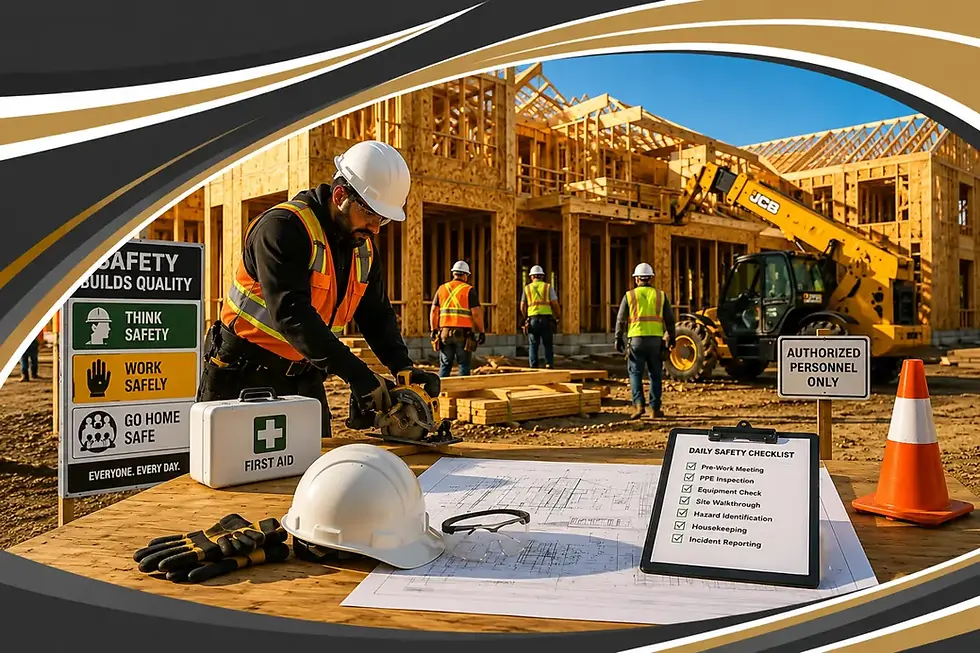


HEALTH, SAFETY & COMPLIANCE
WHY SAFETY MATTERS
READ OUR SERVICE FAQs

Health, Safety & Compliance
Health, safety, and construction compliance play an essential role in every successful residential framing project.
While quality workmanship determines how a structure performs over time, safe construction practices help protect workers, support organized project execution, and contribute to efficient progress throughout the building process.
Residential framing involves structural materials, elevated work areas, heavy components, specialized equipment, and multiple trades working together within an active construction environment.
Careful planning helps create conditions that support both productivity and safe operations from the beginning of construction through structural completion.
Master Framers recognizes that successful framing projects depend upon more than skilled craftsmanship alone.
Every project benefits from organized planning, effective communication, responsible material handling, coordinated scheduling, and construction practices that support safe working conditions throughout the site.
Whether constructing a custom home, a residential addition, a subdivision, or a multi-unit development, health, safety, and compliance remain integral components of professional residential framing.
Health, Safety & Compliance


Why Health, Safety and Compliance Matter During Residential Framing
Residential framing establishes the structural framework upon which every subsequent construction activity depends.
During this stage, crews install floor systems, wall assemblies, engineered beams, roof structures, structural openings, and numerous load-bearing components that require careful coordination throughout the project.
Construction sites continually change as framing progresses. Materials are delivered, equipment moves throughout the property, additional trades prepare for future work, and structural assemblies evolve from foundation to completed framing.
Maintaining organized working conditions helps reduce unnecessary disruptions while supporting safe and efficient project progression.
Safe construction practices also contribute to higher-quality workmanship by allowing crews to focus on structural accuracy, project coordination, and proper sequencing without unnecessary site complications that may interrupt productivity.
Construction Site Planning Before Framing Begins
Successful framing projects begin long before the first wall is assembled. Construction drawings, engineering documentation, municipal approvals, site logistics, material delivery schedules, workforce planning, and equipment coordination all influence how framing progresses once work begins.
Proper planning allows builders, project managers, suppliers, and framing contractors to organize material storage, equipment access, construction sequencing, and trade coordination in a manner that supports both efficient construction and responsible site management.
Early project planning also creates opportunities to identify site-specific conditions that may influence scheduling, access, staging areas, crane operations, telehandler movement, or material delivery throughout construction.
Builders interested in coordinated project planning can learn more through our Construction Site Coordination page.
Worker Safety Throughout the Framing Process
Residential framing requires workers to perform a wide variety of structural tasks that often involve elevated work platforms, roof framing, engineered components, material lifting, repetitive movement, and changing construction conditions. Professional framing crews continually adapt as structures evolve from foundation walls through complete roof systems.
Maintaining organized work areas, following established construction procedures, and coordinating activities between crew members all contribute to safer project execution. Clear communication allows workers to understand project sequencing while helping reduce unnecessary interruptions during structural construction.
As framing progresses, multiple construction activities frequently occur simultaneously. Organized workforce coordination helps ensure that framing operations integrate efficiently with other trades working throughout the project.
Clients interested in workforce planning can review our Backup Workforce for Framing Projects page.
Equipment, Material Handling and Site Organization
Residential framing projects depend upon the efficient movement of structural materials throughout the construction site. Lumber packages, engineered beams, floor systems, roof trusses, sheathing, and hardware must be delivered, staged, and positioned in ways that support ongoing construction while maintaining organized working conditions.
Modern residential construction often relies upon cranes, telehandlers, forklifts, and other equipment to transport materials safely throughout active job sites. Coordinated equipment use helps minimize unnecessary manual handling while improving overall construction efficiency.
Proper site organization also supports smoother material access, improved trade coordination, and reduced congestion as multiple contractors perform work throughout different stages of residential construction.
Construction Compliance Throughout Residential Projects
Residential construction operates within an established framework of building regulations, engineering requirements, approved construction documentation, and workplace safety expectations. Compliance begins with approved plans and continues throughout every stage of structural construction.
Professional framing requires careful interpretation of architectural drawings, engineering specifications, structural details, and approved design documents before construction begins. Accurate execution of these documents supports both structural integrity and overall project quality.
Construction compliance extends beyond the framing contractor alone. Builders, engineers, designers, municipal inspectors, suppliers, and numerous construction professionals all contribute to successful residential projects through coordinated planning and communication.
Clients interested in understanding how framing drawings influence construction can review our Construction Drawings & Framing page.
Communication Between Builders, Site Supervisors and Framing Crews
Effective communication remains one of the most valuable tools available on any construction project. Residential framing frequently involves builders, homeowners, architects, engineers, suppliers, municipal officials, and multiple construction trades working toward shared project objectives.
Clear communication allows construction teams to coordinate scheduling, material deliveries, inspections, structural revisions, equipment requirements, and workforce planning while minimizing unnecessary delays. Organized project communication also helps maintain construction momentum as projects advance through different stages.
Builders seeking long-term framing support often benefit from consistent working relationships that emphasize planning, scheduling, and dependable coordination. Additional information is available on our Builder & Developer Framing Partnerships page.
Safe Construction Supports Better Framing Quality
Quality workmanship and safe construction practices work together throughout every framing project. Well-organized construction sites help crews maintain structural accuracy while allowing builders to coordinate future trades more efficiently as the building progresses toward completion.
Accurate wall alignment, properly constructed floor systems, correctly installed structural components, and organized material handling all contribute to a smoother transition into roofing, windows, mechanical systems, insulation, drywall, and finish construction.
Professional framing combines technical knowledge, organized project management, effective communication, and responsible construction practices to support successful residential building throughout Ontario.
More information about our quality approach can be found on our Framing Standards page.
Framing Consultations Before Construction Begins
Many questions regarding construction safety, compliance, sequencing, and structural planning can be addressed before work begins. Early consultation provides builders and homeowners with an opportunity to discuss framing requirements, project organization, construction scheduling, and overall project objectives before physical construction starts.
Planning discussions often contribute to better project coordination while helping construction teams understand how framing integrates with the broader construction schedule.
Clients interested in discussing upcoming projects can learn more through our Framing Consultations page.
Frequently Asked Questions
Q: Why is health and safety important during residential framing?
A: Health and safety help create organized construction environments that support worker protection, efficient project coordination, and consistent structural workmanship throughout the framing process.
Q: Does construction compliance include following engineered drawings?
A: Yes. Residential framing should follow approved architectural drawings, engineering specifications, and applicable construction requirements so the completed structure reflects the approved design documentation.
Q: How does site organization improve construction projects?
A: Organized material storage, coordinated equipment movement, effective communication, and structured scheduling help reduce unnecessary delays while supporting safer and more efficient residential construction.
Q: Can framing consultations help identify construction planning issues?
A: Yes. Early consultations provide an opportunity to discuss project sequencing, structural planning, construction logistics, and framing requirements before work begins.
Health, Safety & Compliance for Residential Framing
Professional residential framing extends beyond assembling structural components.
Successful projects depend upon planning, communication, responsible site organization, construction compliance, and workmanship that supports efficient project execution from foundation through completed framing.
By integrating health, safety, and organized construction practices into every stage of the framing process, builders and homeowners establish stronger foundations for successful residential construction throughout Ontario.